Predicting Movie Success
Can movie metadata actually predict financial success?
A machine learning project exploring whether publicly available movie attributes can predict ROI-defined commercial success, and what happens when the available data is not enough to explain the outcome.
TL;DR
I explored whether public movie metadata could predict commercial success. Instead of using revenue alone, I defined success through return on investment so the analysis would account for efficiency, not just scale. The final models were weak, but that became the most useful insight: the available metadata described the movie, not the full market system that determines performance.
Movie revenue is easy to measure, but it is not always a fair definition of success.
I began with a simple question: could public movie metadata predict whether a film would be financially successful? Revenue alone would favor expensive blockbusters, so I needed a target that reflected financial efficiency rather than scale.
I defined success using return on investment, calculated as revenue divided by budget. A film was labeled successful when its ROI exceeded 2.75 and unsuccessful when it did not. That threshold was useful for this project, but I treated it as a project framing rather than a universal industry definition.
10,000+ movies, but only a subset of their real-world story.
The raw dataset contained more than 10,000 movie records from TMDB and Kaggle, spanning films released from 1961 through 2015. That scale looked promising, but record count alone did not guarantee that the data captured the forces behind commercial performance.
The usable predictors were budget, popularity, runtime, vote average, and genre. Revenue was used to calculate ROI and the success label, but it was deliberately removed from the model inputs because including it would leak the answer into the prediction.
Turning movie metadata into a classification problem
I cleaned budget and revenue values, removed unusable null or zero records, calculated ROI, and converted the result into a binary success label. Genre was one-hot encoded so it could be used alongside the numerical features.
I started with logistic regression because it offered an interpretable baseline. I then compared it with a multilayer perceptron classifier to test whether non-linear relationships among the same features could improve performance. I evaluated both approaches using accuracy, precision, recall, and F1 rather than relying on one headline number.
The evidence showed why the model struggled.
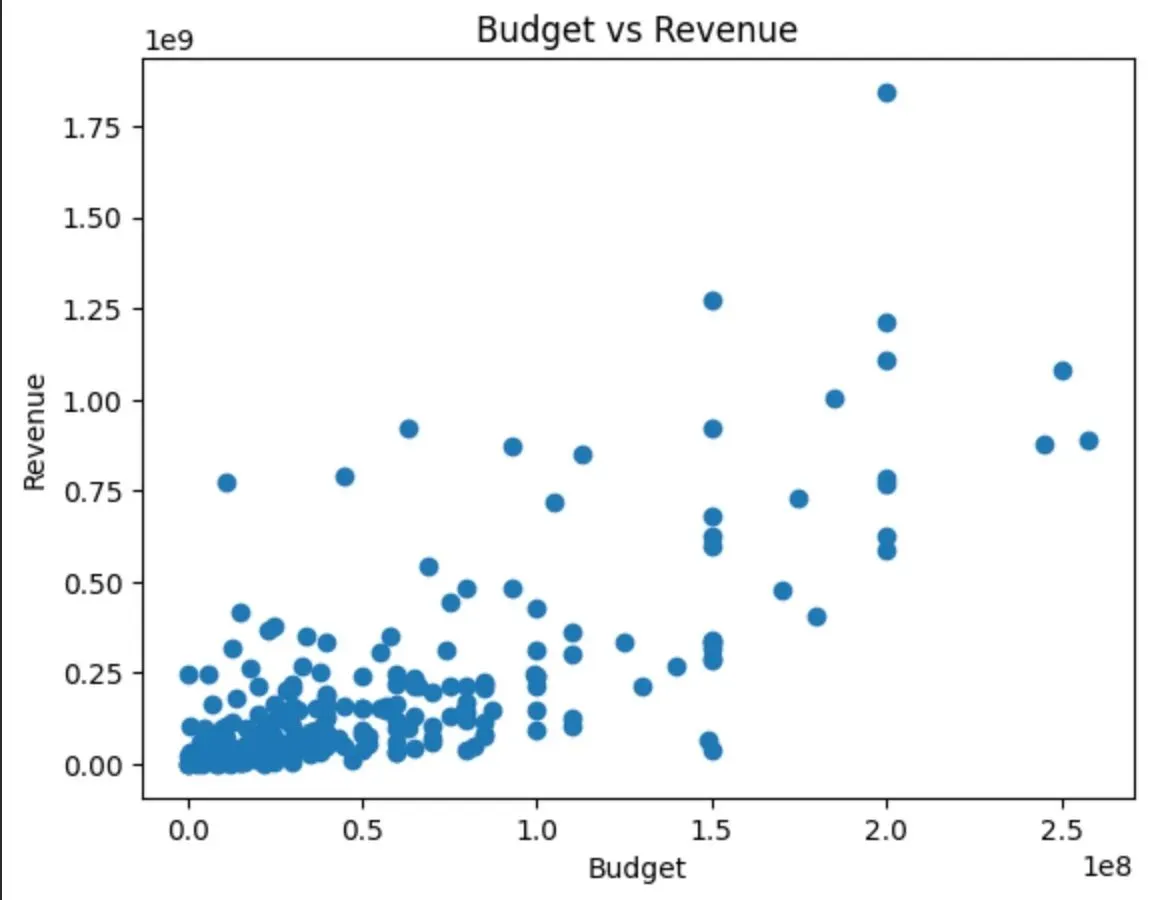
The charts and reports are useful because they make the limitation visible. Similar budgets could produce very different financial outcomes, and genre patterns were interesting but not deterministic.
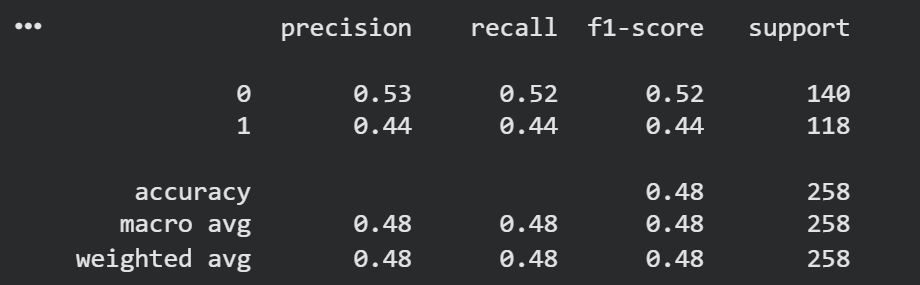
The more flexible model improved performance, but not enough to make prediction reliable.
Logistic regression reached 48% accuracy. For the successful class, precision, recall, and F1 were each approximately 0.44, showing that the baseline struggled to separate successful and unsuccessful films.
The MLP improved accuracy to 54%, a six-point increase. However, it also produced a convergence warning, which meant the difference could not be treated as definitive evidence that the more complex model had solved the problem. On a roughly balanced binary task, 54% is only slightly above chance.
The model was not necessarily the main limitation. The data was.
The models could see budget, genre, runtime, popularity, and vote average. Those variables describe a film, but they do not fully describe the market conditions surrounding its release.
They could not see marketing spend, cast or director star power, release timing, distribution strategy, critical reception, or word of mouth. Any of those missing factors could materially change a film's outcome, even when the available metadata looked similar. The dataset described the movie, but not the complete system that made it succeed.
A more accurate prediction is not automatically a better decision.
A stronger model would still require careful product judgment. Historical movie data reflects unequal access to financing, distribution, marketing, and visibility, so a model trained on past outcomes can reproduce those same patterns.
If predictions were used too literally, familiar commercial ideas could appear safer while smaller or unconventional projects were disadvantaged. That would turn a descriptive pattern into a self-reinforcing funding decision. The model should support human judgment, not determine what gets funded.
What I would do next
My first priority would be improving the feature set rather than immediately adding a more complex algorithm. I would add marketing spend, cast and director indicators, release timing, distribution context, critical reception, and word-of-mouth signals.
I would also standardize the numerical features, log-transform heavily skewed variables such as budget, and compare independent films with major-studio releases instead of assuming one relationship applies across the entire industry. Finally, I would reconsider whether binary classification is the best framing. A continuous ROI prediction or a model designed around different film segments may preserve more useful information than a single success threshold.
A weak model can still produce a strong analytical conclusion.
The most valuable outcome was not high predictive accuracy. It was learning how quickly a technically valid model can become misleading when its inputs do not capture the real-world system behind the outcome.
The project reinforced the importance of preventing leakage, questioning target definitions, interpreting weak results honestly, and considering the social consequences of historical data. A responsible analysis should explain what the evidence cannot support as clearly as what it can.
Study Spot Finder
Helping students discover campus study spaces through location context and community knowledge.
VIEW PROJECT →