WealthSync
Using gamification to build financial confidence without rewarding the wrong behavior.
For JPMorgan Chase Innovate for Impact, my team explored how gamification could make financial progress more visible for young adults without rewarding unhealthy engagement. We designed personalized goals, milestones, and progress mechanics around meaningful financial behaviors and placed second in the competition.
TL;DR
For JPMorgan Chase Innovate for Impact, my team explored how gamification could make financial progress more visible for young adults without rewarding unhealthy engagement. We designed personalized goals, milestones, and progress mechanics around meaningful financial behaviors and placed second in the competition.
What if financial progress felt as visible as spending?
Personal-finance products give users more information than ever. They can see account balances, transactions, credit information, investment performance, spending categories, and financial recommendations, but access to information does not automatically create confidence.
For younger users in particular, financial goals can feel distant, intimidating, and difficult to translate into everyday action. Our team explored a different question: what if a financial product made progress feel as visible as spending? That became the concept behind WealthSync.
Rethinking financial education
A common response to low financial confidence is more education: more articles, more explainers, and more content about budgeting, investing, and credit. The problem is that knowing what someone should do does not necessarily make the behavior easier to start or sustain.
We wanted to explore whether the mechanics that make progress visible in other products, such as goals, milestones, feedback, streaks, and achievement, could be applied to financial wellness. That created an important product risk because gamification can increase engagement, but financial products should not optimize engagement at any cost.
Defining the product principle
We built the concept around one principle: reward progress toward the user's financial goals, not activity for activity's sake. That distinction shaped the features we explored.
The system should not reward someone simply for making more transactions, opening the app more frequently, or taking financially risky actions. Instead, progress should connect to behaviors that support the user's stated goals, such as maintaining a savings habit, completing educational milestones, improving consistency, or reaching personalized targets.
Designing for different definitions of progress
Our research and synthesis led us to consider several user profiles rather than designing for one generic young investor. Different users could have very different definitions of financial progress.
One might be building an emergency fund, another might be learning how to invest, someone else may be focused on becoming more consistent with their spending habits, and another user may simply want to feel less overwhelmed by where to begin. We developed four personas to help pressure-test whether the same product mechanics could support different motivations without assuming everyone had identical goals.
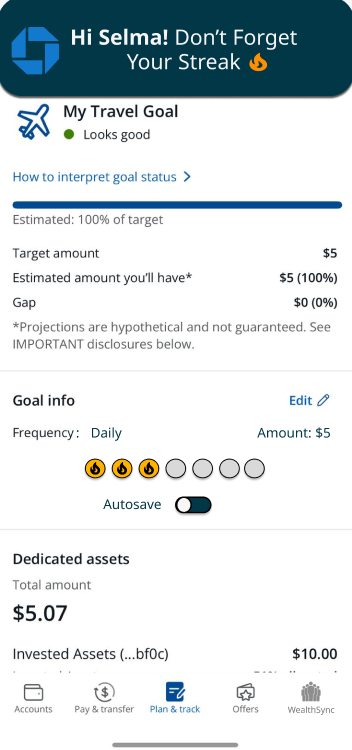
Prototype screens
The existing WealthSync prototype visuals are preserved here while the surrounding case study copy has been simplified into a more editorial narrative.
Designing the product system
The resulting concept combined personalized financial goals with visible progress mechanics. We explored personalized goals, progress tracking, achievement badges, streaks, personalized guidance, community elements, and milestone-based encouragement.
The strategic question behind each feature was the same: does this mechanic help the user understand or sustain meaningful progress? If the answer was only that it made the app more engaging, that was not enough.
Moving from ideas to a roadmap
Because the concept could expand quickly, prioritization became important. A financial wellness product could eventually include budgeting, investing, education, communities, credit, rewards, and more.
We instead created a roadmap around establishing the core behavior loop first. The product needed to understand a user's goal, translate it into visible progress, and give the user a reason to continue. More complex functionality would only become valuable once that loop worked. We also considered system architecture and feasibility so that the product strategy was not disconnected from how the experience would actually operate.
Connecting user value and business value
The case required us to think beyond interface design. We evaluated the product opportunity, target users, roadmap, market context, marketing strategy, and how the experience could create value inside a larger financial ecosystem. That forced us to connect user value, product behavior, and business value.
The strongest long-term opportunity was not simply increasing time spent in the app. A user who becomes more financially confident can deepen their relationship with the financial ecosystem over time, creating a healthier incentive than maximizing short-term engagement.
Result
Our team placed second in the JPMorgan Chase Innovate for Impact competition. The result validated the overall direction, but the project also left us with several questions I would want to test before building.
Would users find financial streaks motivating or stressful? Which achievements would feel meaningful rather than childish? Would users trust personalized guidance? How should the product respond when someone misses a goal? Most importantly, does the experience actually change financial behavior, or does it only make users feel more productive?
What I would test next
My first experiment would isolate the progress loop. I would recruit users with a specific, measurable financial goal and compare a standard goal-tracking experience against one with milestone-based feedback. I would measure completion, return behavior, self-reported confidence, and whether users actually took the intended financial action.
I would also explicitly watch for negative effects. If someone feels punished by losing a streak or pressured to complete an inappropriate financial action, the mechanic is failing even if engagement increases.
What I learned
WealthSync taught me to be more skeptical of product mechanics that are universally described as “engaging.” Engagement is not inherently good. The behavior a product rewards matters. That is especially important in categories such as finance, health, education, or AI, where maximizing interaction can conflict with the user's actual interests.
The project pushed me to think beyond whether a feature could increase usage and ask a more important question: what behavior are we teaching the user to value?
PlateForce
Designing an AI meal-planning system around constraints, not generic recommendations.
VIEW PROJECT →